DIY Engineering Kits

Authentic kits and components, quoted for your school. Add items to your quote list and we'll reply with pricing and delivery.

29 products

Filters

Clear all
Brand
Grade level

29 products

  • Grades 4–5Grades 6–8

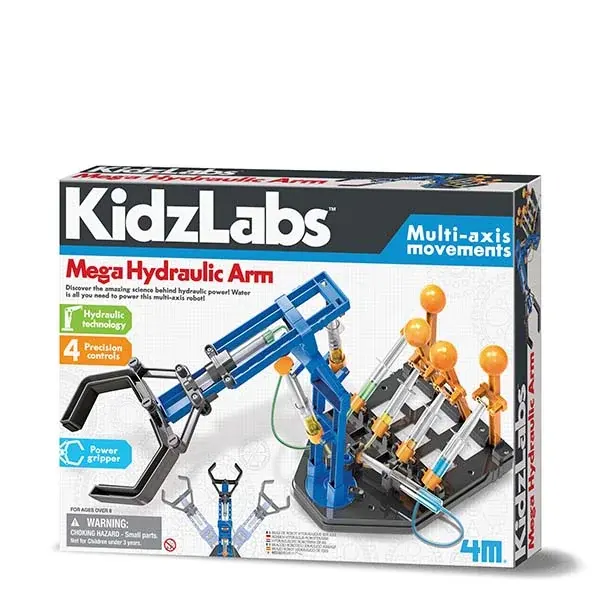
    Mega Hydraulic Arm

    The 4M KidzLabs Mega Hydraulic Arm is a build-it-yourself kit that uses water as the working fluid to move a multi-axis robotic arm. Children assemble the base, arm frames and claw, then fill syringe-and-tube sets with water to create four independent hydraulic circuits. Four handles on the base control the arm: one opens and closes the claw, two raise and lower different sections of the arm, and one rotates the arm from side to side. Pressing a plunger pushes water through the tube to move the matching joint, showing how force is transmitted through an incompressible fluid, the same principle used in cranes and construction machinery. The kit contains the plastic parts, eight syringes, tubing, claw pads and screws. A small crosshead screwdriver, some lotion as a lubricant and a clean used tin can are needed from home. Adult supervision is recommended during assembly.
  • Grades 4–5Grades 6–8

    Motorised Robot Hand

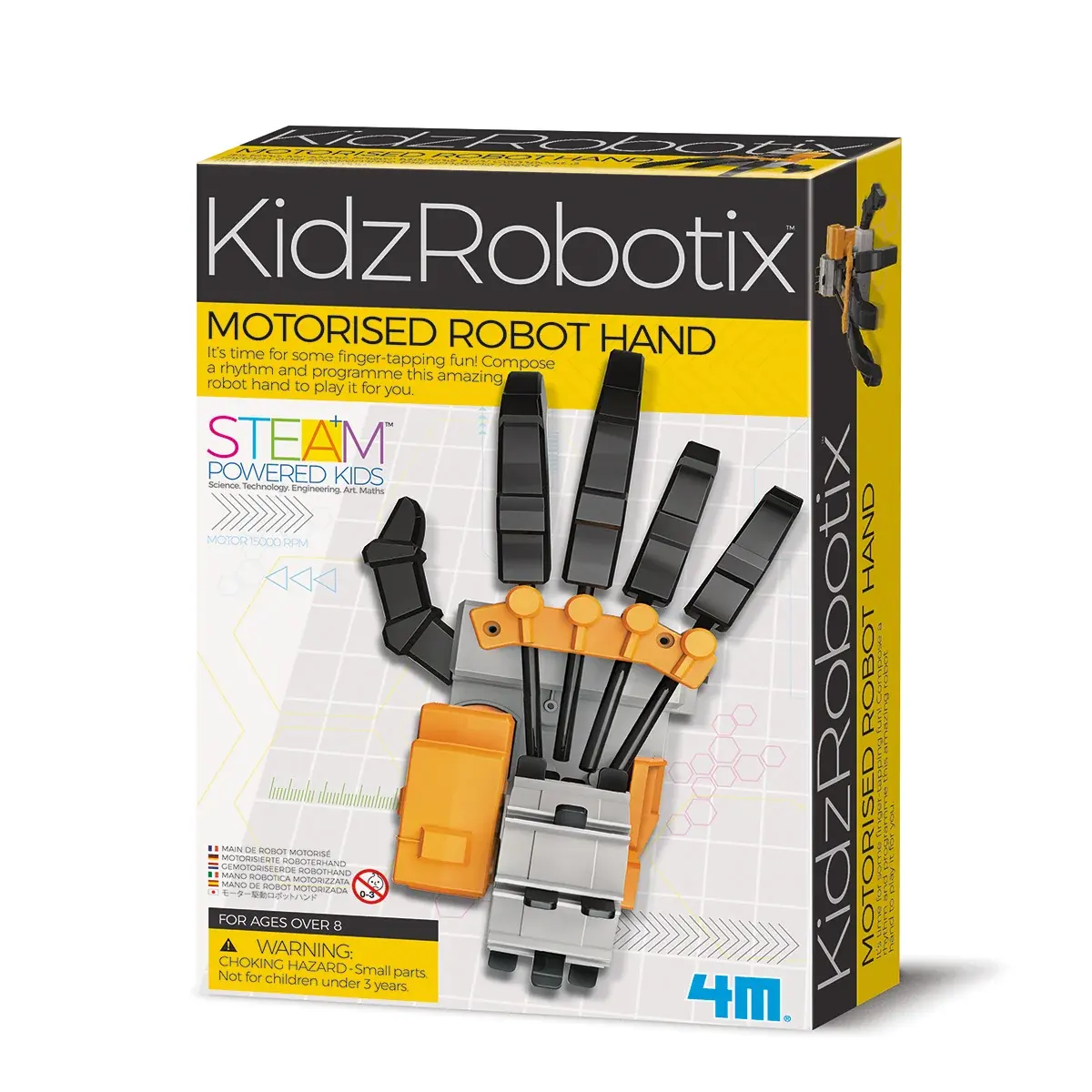
    The 4M KidzRobotix Motorised Robot Hand introduces robotics and human anatomy through a hand model whose fingers tap out tunes and beats. Children assemble a motor and gearbox, the base, a rotating drum and four articulated fingers plus a thumb. The hand is programmed mechanically: pegs placed in the drum's slots lift the fingers as the drum turns, so each pattern of pegs becomes a rhythm. The kit includes program templates for planning patterns before transferring them to the drum. A gearbox slows the motor and includes a ratchet that protects the gears if the drum jams, while each finger works as a lever. Everything needed to build the hand is included except a small crosshead screwdriver and two AAA batteries. It is a good classroom link between programming, sequences and the mechanics of levers and gears.

  • Grades 4–5Grades 6–8

    Tin Can Robot

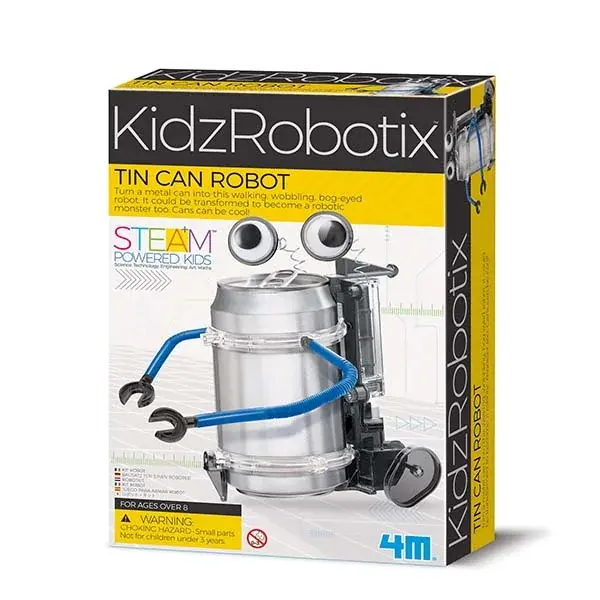
    The 4M Tin Can Robot kit shows children how to give a used drink can a second life as a walking robot. The can slides into body rings and is fitted with a motor, gears, legs, gripper hands and moving eyes. Once switched on, the motor turns a worm gear and an axle with cams, which lift each side of the robot in turn so it wobbles forward with a buzzing sound. By adjusting the cam angles, children can change how it walks, and by swapping the wires and laying it on its side they can turn it into a sideways-walking robotic monster. The instructions also explain cams, reduction gears and how the can amplifies vibrations through resonance. All parts are included apart from one AA battery, a small crosshead screwdriver and a clean, used tin can. Adult help is advised because metal parts may have sharp edges.

  • Grades 4–5Grades 6–8

    Tin Can Cable Car

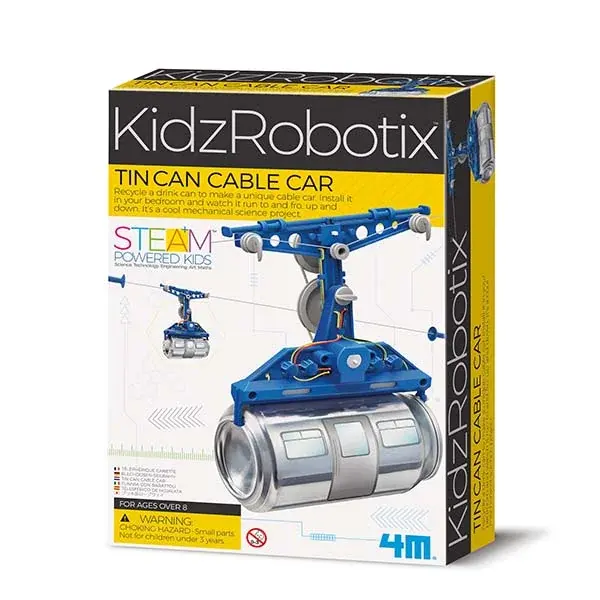
    With the 4M Tin Can Cable Car, children turn an empty drink can into a working cable car. They build a wheel support with a motor and pulleys, attach the can as the car body with window stickers, and string a cable line between two points at least 2 metres apart, such as two chairs. The motor drives a power pulley that grips the string through friction, pulling the car along the line. When the car reaches a stop at the end of the cable, a reversing shaft flips the reversing switch and the car heads back the other way, so it runs to and fro automatically. The guide explains how pulleys act like gears to reduce speed and how reversing the current changes the motor's direction. The kit requires two AA batteries, a crosshead screwdriver and a used soda can, none of which are included.

  • Grades 4–5Grades 6–8

    Table Top Robot

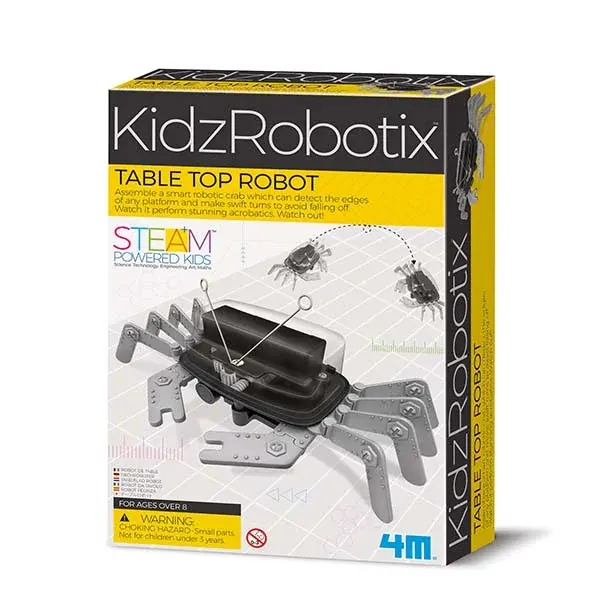
    The 4M Table Top Robot is a battery-powered robotic crab that children assemble themselves. Once built and switched on, it walks sideways across a table and turns when it reaches the edge so it keeps moving without falling off. Its edge detection is purely mechanical: when rollers pass over the edge of the table, a third wheel set at right angles touches the surface and steers the robot back until the rollers are on the table again. Cams on the axle move the plates that carry the eight legs and two claws, creating the crab-like scuttle. The guide links the design to real mobile robots that use sensors to avoid edges and obstacles. The kit includes a chassis with pre-installed motor, transparent cover, legs, claws, gears and an antenna. One AA battery and a small crosshead screwdriver are needed. It won a 2014 Parents' Choice Approved Award.

  • Grades 4–5Grades 6–8

    Bubble Robot

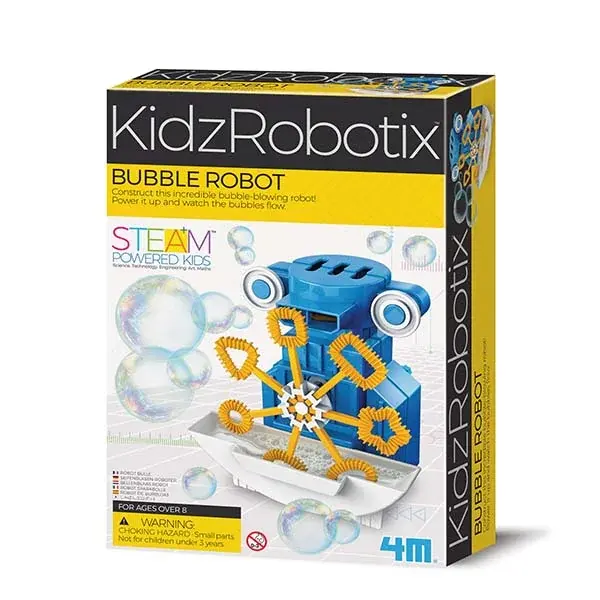
    The 4M Bubble Robot is a build-it-yourself robot that produces a steady stream of bubbles. Children fit a motor and fan into the robot body, connect the wiring at terminal blocks, and attach a rotor with seven bubble wands and a trough for the bubble solution. When switched on, the motor spins the fan, which draws air in through the top and blows it out through a front slot. Gears slow the motor's speed to turn the rotor, so each wand dips into the solution and passes in front of the air stream to release bubbles. The instructions include recipes for homemade bubble mixture and fun facts about surface tension and why bubbles are round. The kit includes the body parts, motor, fan, bubble wands and bubble solution. Two AAA batteries and a small crosshead screwdriver are required. Bubble play is best done outdoors or on a covered surface.

  • Grades 4–5Grades 6–8

    Salt Powered Robot

    The 4M Salt Powered Robot lets children build a robot mini vehicle and then power it with batteries they make themselves. After assembling the chassis, wheels, motor, upright body and arms, they construct two battery cartridges from magnesium sheets, fabric sheets, copper sheets and active carbon. Adding salty water to the cartridges starts a chemical reaction that generates electricity, which drives the motor and moves the robot. This turns an abstract topic, how batteries work and how chemical energy becomes electrical energy, into a hands-on experiment that fits well into green energy and chemistry lessons. The kit contains the robot parts, battery cartridges, magnesium, fabric and copper sheets, active carbon, a dropper, a cup and screws. Table salt and a spoon are needed from home, and adult supervision is required throughout.

  • Grades 4–5Grades 6–8

    Solar Plane Mobile

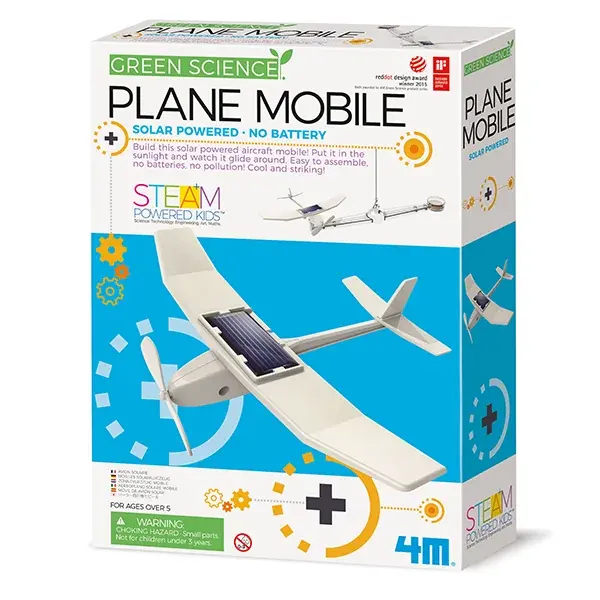
    The 4M Solar Plane Mobile is a green science kit in which children assemble a small aircraft with a solar panel on its wing and hang it from a balanced mobile structure. When sunlight falls on the panel, the motor spins the propeller and the plane glides around in circles, with no batteries needed. Building the plane involves fitting the motor into the nose, joining the body halves, attaching the wing, stabiliser and propeller, and connecting the solar panel. The mobile is balanced with coins in a weight holder and can be hung by its ball chain or set on a used drinks bottle using the included bottle cap. The kit introduces solar energy, simple circuits and balance in an easy project. A crosshead screwdriver, coins and a used drinks bottle are needed from home. A desk lamp can be used indoors under adult supervision. It received a 2016 Academics' Choice Brain Toy Award.

  • Grades 4–5Grades 6–8

    Solar Rover

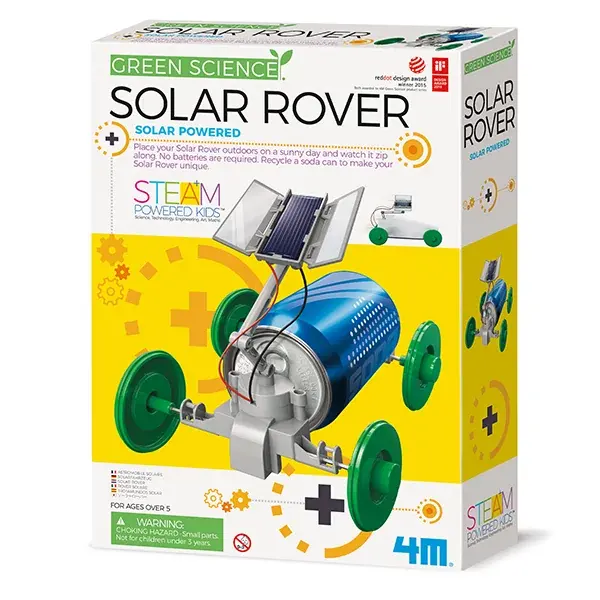
    The 4M Solar Rover is a green science kit in which children build a small vehicle that drives on sunlight alone. They assemble the chassis, fit the motor so its worm gear meshes with the rear axle gear, add four wheels, and mount an adjustable solar panel with reflectors on a support arm. A clean, empty soda can becomes the rover's body, encouraging recycling, and a transparent plastic shell is also included as an alternative body. In sunshine, the panel's solar cells generate current that turns the motor, while the gears slow the wheels so the motor can drive them more easily. Indoors, a 60-watt incandescent desk lamp can stand in for the sun under adult supervision, which is handy for school science fairs. A small crosshead screwdriver and an empty soda can are needed from home. No batteries are required.

  • Grades 4–5Grades 6–8

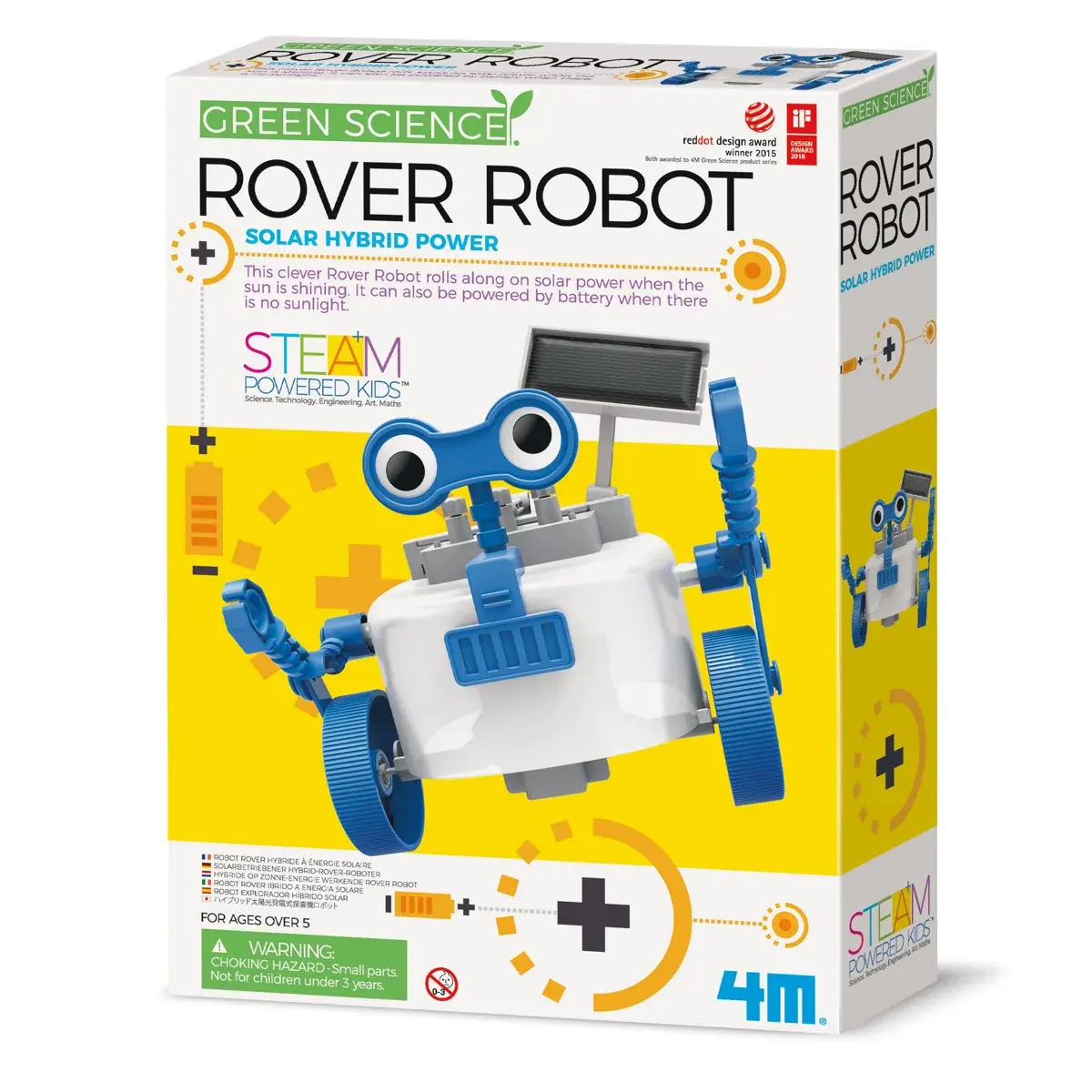
    Solar Hybrid Rover Robot

    The 4M Hybrid Solar-Powered Rover Robot is a buildable robot with two power sources. Children assemble the body, gearbox, wheels, arms, eyes and an adjustable solar panel on a support arm, then wire the solar unit and battery holder to the motor. A switch selects the power mode: in sunshine, the solar panel drives the motor directly; when there is not enough light, the robot runs from a battery instead, so it can be used indoors and on cloudy days. The gearbox reduces the motor's speed so the robot rolls along at a steady pace. The guide explains how solar cells convert light into electricity and where hybrid solar-battery systems are used in everyday devices. One AAA battery and a small crosshead screwdriver are required and not included. Adult supervision is recommended during assembly.
  • Grades 4–5Grades 6–8

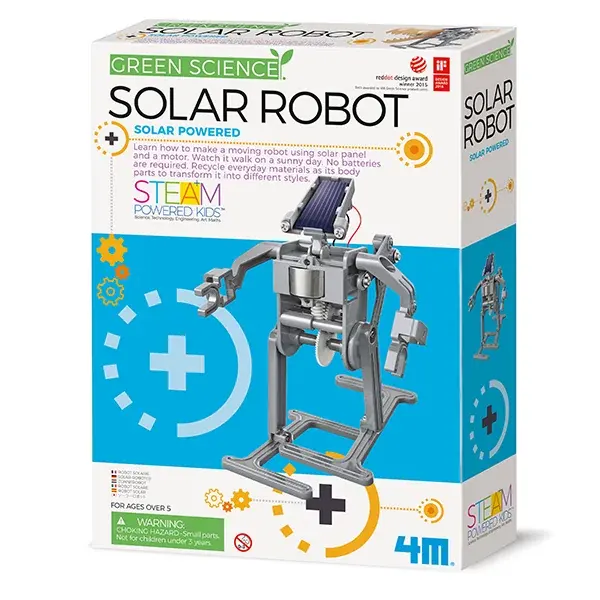
    Solar Robot

    The 4M Solar Robot teaches children how a solar panel and motor can make a machine walk. They attach left and right legs, feet, leg links and arms to a gear case that already contains the motor and cams, then mount the solar panel on its holder. In sunshine, the solar panel powers the motor, and the cams move the legs and arms so the robot walks without any batteries. Using the included template and everyday items such as a paper cup and forks, the robot can be transformed into a dinosaur or monster robot, encouraging creative reuse of household materials. The kit contains the solar panel, gear case with motor, legs, arms, feet, screws and a dinosaur head and tail template. A small crosshead screwdriver, an empty paper cup and two forks are needed from home, and adult supervision is required.

  • Grades 4–5Grades 6–8

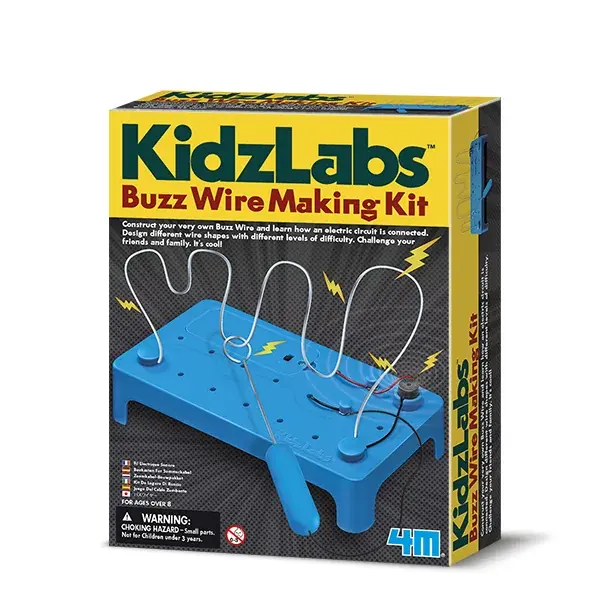
    Buzz Wire Making Kit

    The 4M KidzLabs Buzz Wire Making Kit lets children build the classic steady-hand game while learning how an electric circuit works. They shape a bendable metal wire into a course, make a wand loop with a handle, and connect a battery case and electric buzzer on a pegged plastic platform. To play, the player guides the wand from one end of the shaped wire to the other without touching it. If the wand makes contact, the circuit is completed and the buzzer sounds. Because the wire can be bent into any shape, children can design courses of different difficulty and challenge friends and family to the fastest buzz-free run. The kit includes the platform, handle, battery case, buzzer, plastic and metal pegs, bendable metal wire and insulated wire. Two AA batteries and a wire cutter are needed; adult help is advised when cutting and bending the wire.

Need a full classroom or lab?

We build bundles for 24–30 students with storage and charging, and can install and train your teachers.

Talk to us